

Why do you wear that?: An introduction to the “O-nenju” and “Montoshikisho” By Rev. Anne Spencer
If you come to a service at our temple, you may notice that some of the people at service are wearing or carrying some items that may be unfamiliar to you. This article will introduce 2 of these important items: the O-Nenju and the Montoshikisho.
O-Nenju
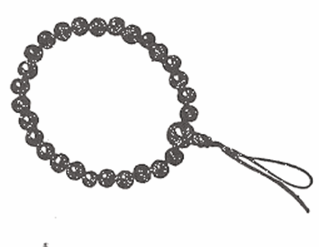
The Nenju or O-nenju is a circular set of beads worn/carried on the left hand. The length of the O-nenju might be small (worn like a bracelet around the wrist) or larger and carried in the left hand. In Buddhism, these beads represent our negative and selfish thoughts and feelings that motivate us in ways that hurt ourselves and others. A full-sized bead chain has 108 beads, but at our Jodo Shinshu temples most people wear or carry a much smaller O-nenju. During certain parts of our temple services, people place the palms of their right and left hands together (in a gesture called “gassho” which literally means “palms together”) with the o-nenju around both hands while bowing. Carrying/wearing the beads on the left hand is a reminder that we are incomplete/imperfect—that no matter how hard we try, as humans, we will experience the “3 poisons” of greed, anger, and ignorance. And putting our left and right hands together, surrounded by the circle of beads, reminds us of the greater truth that we are ultimately more than just our limitations and foolishness--we are also part of the rest of the universe. Holding our palms together is a physical representation of our connectedness to our community and to the infinite compassion of Amida Buddha. We are both small foolish beings AND we are part of universe that is infused with the beauty of wisdom and compassion.
Montoshikisho
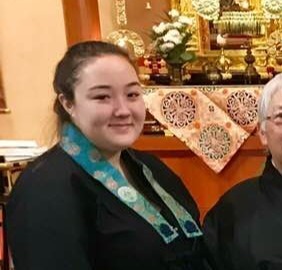
The montoshikisho is a strip of fabric, often made of brocade or other decorated material, formed into a loop--usually with the 2 ends of fabric connected by a cord. People place the montoshikisho around their necks during Buddhist services. The design of the montoshikisho is inspired by the robes worn by ordained monks and nuns. But there are no special requirements to wear a montoshikisho—it is simply a sign of respect for the service a person is participating in, and reflects a desire to connect with the larger Buddhist community.
Special montoshikisho with unique patterns are often commissioned to commemorate a special occasion, such as Temple Anniversary. Wearing matching montoshikisho can create a sense of community and can make nice conversation-starters, providing an opportunity to make new Dharma friends. The montoshikisho connects us to other Buddhists in the past and inspires new relationships in the present.
Montoshikisho are adaptable and can be worn over either kimono or Western- style clothing.
I like to think of the Montoshikisho as a way to look outward, connecting us with the larger community of Buddhists, while the O-nenju encourages us to look inward, recognizing our own attachments and tendencies toward greed, anger, and ignorance. Looking both outward and inward helps us see ourselves and the world around us with, perhaps, a little bit more wisdom and compassion.